Why Your Best People Stop Speaking Up
Silence in a meeting is rarely agreement. Often it is a quiet calculation about whether speaking is worth the risk.
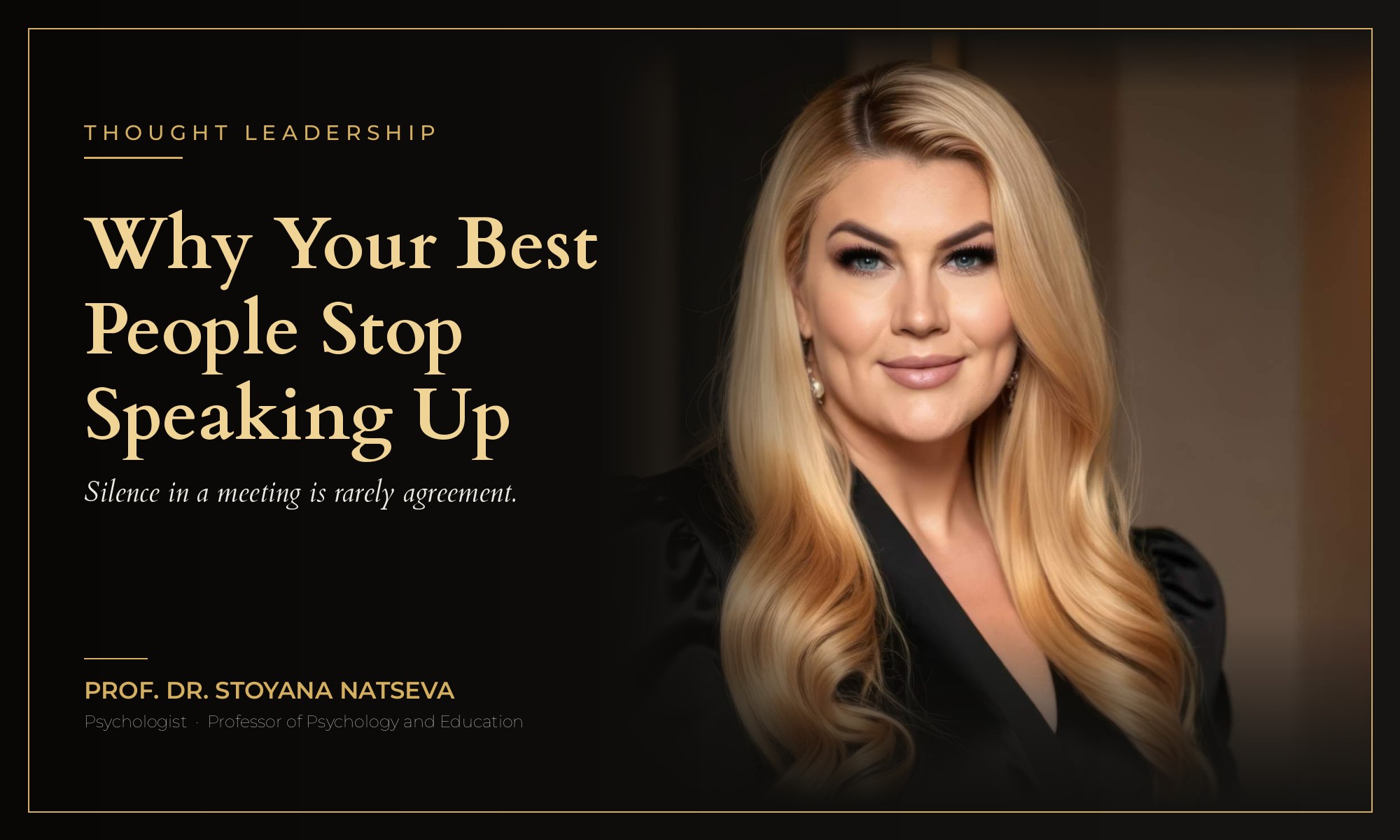
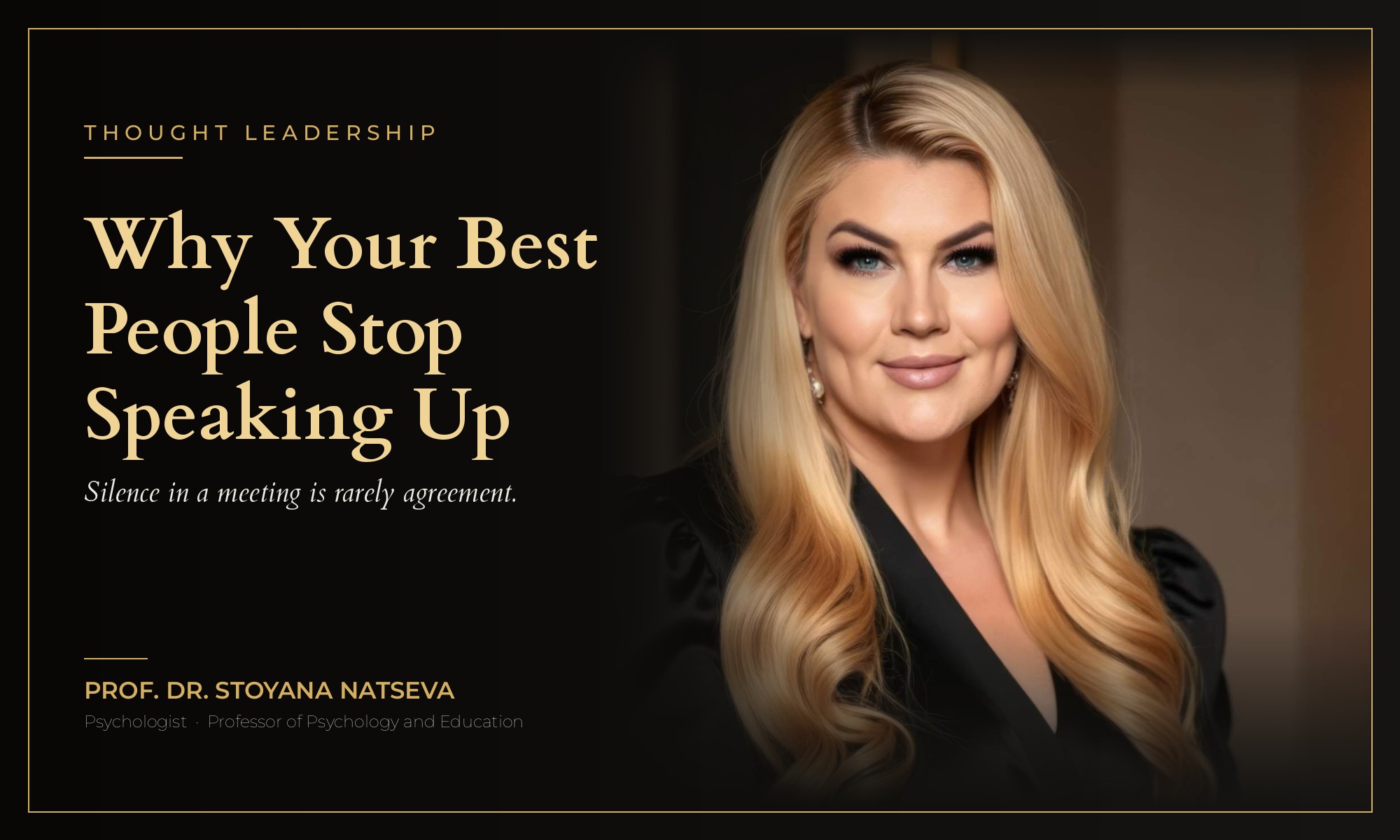
Author: Prof. Dr. Stoyana Natseva
Date: November 23, 2026
The meeting goes smoothly. You present the plan, ask if there are any questions, and the room is quiet. A few people nod. Someone says, "Sounds good." You leave believing the team is aligned.
Three weeks later, the project runs into exactly the problem one of your most capable people saw coming. When you ask why no one raised it, the answer is uncomfortable: "I didn't think it would change anything."
For leaders, this is one of the most expensive forms of silence. It does not show up in reports. It shows up later, in delays, mistakes and good people who slowly stop caring.
Silence is more common than leaders think
In an exploratory study based on interviews with 40 employees from a range of industries, researchers Frances Milliken, Elizabeth Morrison and Patricia Hewlin found that 85 percent had, at least once, felt unable to raise an issue or concern with their bosses, even when they believed it was important. The topics they kept to themselves were not trivial: problems with processes, disagreement with decisions, concerns about performance and ethics.
This kind of silence is not limited to people who have stopped caring. Experienced employees who are close to the work can make the same choice. They stay quiet because, in their judgement, speaking up would cost more than it would bring.
What people weigh before they speak
Before raising a concern, most people make a quick, often unconscious, calculation. Will I be seen as negative? Will it damage my relationship with my manager? Will anything actually change?
These questions reflect two concerns: whether speaking up is safe, and whether it will make a difference. Harvard Business School professor Amy Edmondson's research addresses the first through the concept of psychological safety: a shared belief within a team that it is safe to take interpersonal risks, such as asking a question, admitting a mistake or disagreeing. Her research has shown that teams with higher psychological safety are more willing to discuss errors and learn from them. When Google studied what made its most effective teams work, psychological safety came out as the most important factor among the dynamics it examined.
Psychological safety is not about being nice or avoiding conflict. It is about whether people believe that honest input will be received rather than punished.
How leaders create silence without meaning to
Few leaders intend to discourage honesty. Silence usually grows from small, repeated moments.
A leader asks for feedback after the decision has clearly been made. A question is answered with visible impatience. Someone points out a risk and is labelled "not a team player." A mistake is met with blame rather than curiosity. Each moment on its own seems minor. Together, they teach the team what is safe to say.
What leaders can do differently
Ask before you decide. Invite input while the decision is still open. "Here's what I'm considering — what am I missing?" signals that the answer can still change something.
Ask specific questions. "Any questions?" usually produces silence. "What's the biggest risk you see in this plan?" or "If this fails in three months, what will the reason be?" gives people permission to name problems.
Respond to the first concern carefully. The way you react the first time someone disagrees will shape what the whole team does next. Thank them, explore the point, and if you decide not to act on it, explain why.
Close the loop. When suggestions disappear without a reply, people learn that their input does not matter — even if no one ever says so directly. When someone raises an idea or a concern, tell them what happened with it. Even "We looked at it and decided not to change course, and here is why" shows that their input was taken seriously.
Admit your own mistakes. When leaders acknowledge their errors openly, they make it easier for others to do the same. A team rarely becomes more honest than the person leading it.
Listen for what is not being said
Silence in a meeting can mean agreement. It can also mean uncertainty, fatigue, or a decision that speaking up is not worth it. Strong leaders do not assume they know which one it is. They create the conditions in which people choose to speak.
The best ideas and the earliest warnings are often already in the room. The question is whether your team believes it is safe to share them.
Prof. Dr. Stoyana Natseva is a psychologist, Full Professor (Profesor Titular B) of Psychology and Education at Universidad Azteca, Professor of Practice in Business Psychology at Dunster Business School, and Founder and CEO of Happy Life Academy®.

Worth Minds · The Orbit Edition
30 Stories Beyond Earth
Put your name forward for consideration and become part of a collection of stories designed to inspire generations.
Submit NominationCurrent Issue

Worth Minds · The Orbit Edition
30 Stories Beyond Earth
Put your name forward for consideration and become part of a collection of stories designed to inspire generations.
Submit NominationWorth Minds · The Orbit Edition
30 Stories Beyond Earth
Put your name forward for consideration and become part of a collection of stories designed to inspire generations.
Submit NominationAll Rights Reserved