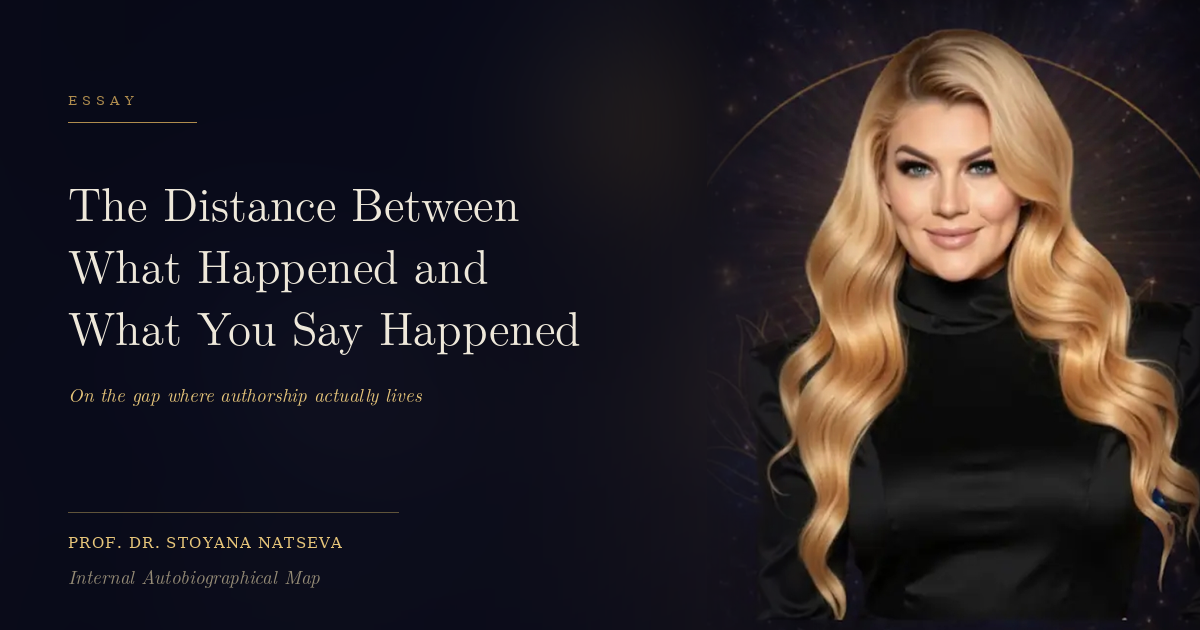
Author: Dr. Stoyana Natseva
Date: September 25, 2026
The Distance Between What Happened and What You Say Happened
Why the story you tell about your life is not a record of it — and why that distinction changes everything about leadership
Prof. Dr. Stoyana Natseva
The Event Is Not the Story
Ask two people who sat through the same failed negotiation what happened in the room, and you will receive two different accounts.
Not two different opinions about the same account — two different accounts.
One remembers the moment the client went quiet. The other never registered the silence at all, but recalls with precision the phrasing of a question that the first person has entirely forgotten.
We tend to treat this as a problem of memory. Someone was distracted; someone else was paying closer attention.
The more useful reading is that nothing was lost. Both people were doing the same thing, and doing it well: constructing a story that made sense of the room they were in.
The events did not arrive pre-organised. Meaning was added afterwards, and it was added by them.
This is not a small observation. It sits underneath almost everything I have worked on for the past two decades.

The Gap Between What Happened and What We Believe
An event is what occurred. A story is what the event was made to mean.
Between the two lies a gap that we almost never notice, because we cross it instantly and without effort.
A colleague does not reply to an email for four days.
That is the event.
He is avoiding the conversation is the story.
He is overwhelmed and my message is not urgent is a different story built on identical material.
The gap between the two is where a working relationship is either preserved or quietly damaged — and nothing in the event itself determines which.
What makes this consequential is that we do not experience the story as a construction. We experience it as perception.
It does not feel like an interpretation we selected; it feels like the plain fact of what is going on.
That is precisely why the gap is so difficult to see from inside it.
Why the Stories Are Not Random
If interpretation were arbitrary, we would produce a different account each time. We do not.
Most people generate remarkably consistent stories across situations that share nothing in common on the surface — the same conclusion arrives after a lost client, a strained marriage, a delayed promotion.
The consistency comes from somewhere.
In my research I have described that structure as the Internal Autobiographical Map: an organised set of interpretive patterns, formed early and reinforced through repetition, which determines what a person notices, what they discount, and what conclusion feels self-evident to them.
It is a map in the ordinary sense — it does not create the terrain, but it decides which features appear on the page and which are left off.
Two executives receive identical critical feedback.
One hears a request for improvement. The other hears confirmation of something they have suspected about themselves for thirty years.
The feedback was one event. The maps were not the same.

The Predictive Turn
Here is where this stops being an interesting observation about perception and becomes something more demanding.
The way a person describes themselves is not only a record of what has already happened to them. It functions as a forecast — and, uncomfortably often, as an instruction.
Someone who has concluded that they are not the kind of person who is taken seriously in a room like this will enter the room differently.
They will speak later, qualify more, and read neutral expressions as confirmation.
The room responds to what it is given.
The conclusion is then confirmed, and the map is reinforced by evidence the map itself helped produce.
This loop is not mysterious and it is not mystical. It is simply what happens when an interpretive structure is allowed to run unexamined over a long period.
The self-description behaves less like a description and more like a specification.
What This Means for Anyone Who Leads
Leadership tends to be discussed in terms of decisions, and decisions in terms of information.
Gather better data, weigh it more carefully, decide.
But every decision is preceded by an interpretation, and the interpretation is rarely audited.
A leader who reads a team's hesitation as resistance will manage a different organisation than one who reads the same hesitation as a signal that the brief was unclear.
Both are responding to real behaviour. Neither is being irrational.
They are working from different maps, and their organisations will diverge accordingly — not because of any single decision, but because of thousands of small interpretive acts, each one invisible.
The practical implication is narrower and more useful than it might sound.
It is not that leaders should distrust their judgement.
It is that there is a step before judgement that most people have never been taught exists, and that step can be examined.
Where the Work Actually Begins
In applied practice I work with a sequence that begins with awareness — the recognition that an interpretation is occurring at all — and moves through recognising the specific pattern, identifying the resources available in the present rather than the ones that were absent in the past, forming a new internal decision, and grounding it in behaviour until it holds without effort.
The order matters, and the first step is the one people most want to skip.
You cannot revise a story you have not noticed you are telling.
Most attempts at personal or organisational change fail at exactly this point: new behaviour is imposed on top of an unexamined interpretation, and the interpretation wins.
It always wins, because it is operating a level below the behaviour and it is not being contested.
The Uncomfortable Freedom in This
There is a version of this argument that becomes cruel — the suggestion that if your story is constructed, then your difficulties are somehow your own invention.
That is not the claim, and it should be rejected firmly.
Events are real. Loss is real. Structural disadvantage is real, and no amount of reframing dissolves it.
The claim is narrower.
Between the event and its meaning there is a gap.
The gap is usually small, it is almost always invisible, and it is the only part of the sequence over which a person has genuine authorship.
That is not an unlimited freedom.
But it is not a trivial one either.
The Beginning of Change
It is the difference between a life that is happening to you and one you are, in some real and partial sense, writing.
Most people never learn that the gap is there.
Once you have seen it, you cannot entirely unsee it — and that, in my experience, is where change actually starts.
About the Author
Prof. Dr. Stoyana Natseva
Prof. Dr. Stoyana Natseva is the founder of Happy Life Academy® and President of IAPTC®.
Her research on the Internal Autobiographical Map and the Direct Change Solution® methodology is published in peer-reviewed journals and indexed monographs.
ORCID: 0009-0008-1692-1935
Current Issue

All Rights Reserved