Leadership·Blog
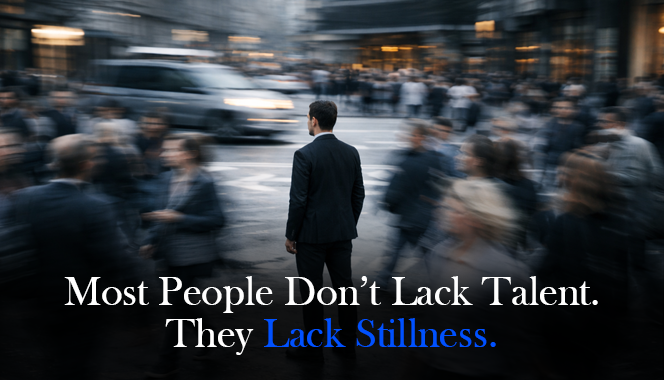
Most People Don't Lack Talent. They Lack Stillness.
In a culture addicted to motion, the leaders who succeed long-term aren't always the busiest. They're the ones who know when to stop.
Author: Worth Minds
Date: March 02, 2026
Most People Don't Lack Talent. They Lack Stillness.
Think about the most capable person you know. Not the most decorated, not the most productive by conventional metrics, the most genuinely capable. Chances are, there is something noticeably unhurried about them. They listen before they speak. They sit with a problem before they solve it. They do not confuse movement with momentum.
Now think about the people who never quite reach their potential, despite undeniable ability. The gifted strategist who can never finish what they start. The brilliant communicator who burns through opportunities. The technically excellent professional who somehow always seems to be reacting, never directing. What they lack is rarely skill. What they lack, almost always, is stillness.
This is not a metaphor. It is one of the most underexamined dynamics in leadership and professional development, and one of the most consequential.
The Noise We Confuse for Progress
Modern professional culture has a deep structural bias toward visible activity. We reward responsiveness over reflection, urgency over clarity, and volume over depth. The calendar packed with back-to-back meetings signals commitment. The executive who replies to emails at midnight signals dedication. The person who is always busy must, by some unspoken logic, be doing important work.
But busyness and effectiveness are not the same thing, and confusing the two is one of the most expensive mistakes a professional can make. Research in cognitive psychology consistently shows that our best thinking, the kind that generates insight, not just output, happens not during peak stimulation, but in the quieter intervals between tasks. The shower epiphany is not a cliché. It is neuroscience.
The problem is that stillness has a perception problem. In most organisations, the person staring at the window is assumed to be disengaged. The person with nothing scheduled on Friday afternoon is assumed to be underperforming. We have built professional environments that are structurally hostile to the very cognitive conditions under which good judgment and original thinking actually flourish.
What Stillness Actually Means in Practice
“Stillness is not the absence of action. It is the presence of intention, the clarity that comes from knowing, before you move, why you are moving.”
“Stillness is not the absence of action. It is the presence of intention, the clarity that comes from knowing, before you move, why you are moving.”
It is worth being precise here, because stillness is often misread as passivity. It is not. The still leader is not the disengaged one, the slow one, or the one who avoids hard decisions. Stillness, in the professional sense, is the capacity to create space between stimulus and response to resist the pull of reflexive action long enough to act with genuine deliberateness.

Marcus Aurelius, who governed an empire while writing some of the most enduring observations on human psychology ever committed to paper, described this as the discipline of the will: the ability to meet the world’s chaos with an ordered interior. He was not recommending withdrawal. He was governing. He was campaigning. He was making decisions with empire-wide consequences. But he did it from a place of internal quiet that most of his contemporaries, and most of ours, never find.
In contemporary leadership terms, this looks like the executive who, before responding to a crisis, takes thirty minutes to think alone. The manager who, rather than filling every silence in a difficult conversation, lets the silence do its work. The founder who builds reflection into their weekly rhythm not as a luxury, but as a discipline, because they have learned that their best decisions come not from the heat of the moment, but from the cool after it.
Why Talented People Stay Stuck
Here is the uncomfortable truth that most leadership development frameworks never quite state plainly: talented people can get extraordinarily good at staying busy in ways that feel like progress but functionally are not.
When you are naturally capable, the world gives you a lot of problems to solve. You become the person others turn to. Your calendar fills up. Your output is high. And somewhere in that current of constant demand, the deeper questions - What am I actually building? What do I genuinely think? What matters here, and what is just noise? Stop getting asked. Not because you stopped caring about them, but because you stopped making space for them.
This is the particular trap of talented professionals: their capability becomes its own obstacle. They are too competent to be forced to slow down, and too busy to choose to. The result, over time, is a kind of sophisticated drift, technically impressive, directionally uncertain.
The leaders who break this pattern almost always describe a similar turning point: a moment when they stopped treating stillness as something that happened to them when everything else was done, and started treating it as something they protected with the same seriousness they gave their most important meetings.
Building a Practice, Not Just a Philosophy
None of this is useful if it stays abstract. The question is not whether stillness matters - it does, but how to build it into the actual texture of a professional life.
The most effective approach is not dramatic. It does not require a meditation retreat or a sabbatical, though neither would hurt. It requires, first, an honest audit: Where in your current rhythm do you have genuine space for unstructured thought? Not a commute with a podcast, not a lunch spent clearing email, actual open cognitive space, where your mind can wander productively, and your thinking can settle?

For most high-performing professionals, the answer is: almost nowhere. And once you see that, it is hard to unsee.
The second step is protection. Block the time before something else fills it. Treat it as non-negotiable. The specifics matter less than the consistency, whether it is thirty minutes of walking without a phone each morning, a Friday afternoon with no meetings, or a journal kept not for output but for clarity. What you are building is not a routine. You are building the habit of returning to yourself.
“The most powerful thing a leader can do in a world of constant noise is learn to hear themselves think.”
The Long Game
Talent is the starting point. But the people who do something lasting with their talent are, almost without exception, people who found a way to stay connected to their own thinking, to maintain, amid the demands and the noise, some quiet centre from which they could operate.
This is what separates the professional who peaks early from the one who compounds over decades. Not work ethic. Not intelligence. Not even opportunity. The capacity to be still long enough to know what they actually think, want, and believe, and to act from that place rather than from the pressure of the moment.
Talent gets you in the room. Stillness determines what you do once you’re there.

Key Takeaway
In a professional culture that rewards visible motion, stillness is a form of courage. It means resisting the pressure to perform busyness and choosing the harder, quieter work of genuine thought. Talent is common. The willingness to cultivate the conditions where talent can actually function, to protect your thinking before the world fills it with tasks, is far rarer. That willingness, more than any skill or credential, is what separates those who remain capable from those who become consequential.

Worth Minds · The Orbit Edition
30 Stories Beyond Earth
Put your name forward for consideration and become part of a collection of stories designed to inspire generations.
Submit NominationCurrent Issue
Worth Minds · The Orbit Edition
30 Stories Beyond Earth
Put your name forward for consideration and become part of a collection of stories designed to inspire generations.
Submit NominationWorth Minds · The Orbit Edition
30 Stories Beyond Earth
Put your name forward for consideration and become part of a collection of stories designed to inspire generations.
Submit NominationCopyright © 2026 Worth Minds -
All Rights Reserved
All Rights Reserved