Legacy·Blog
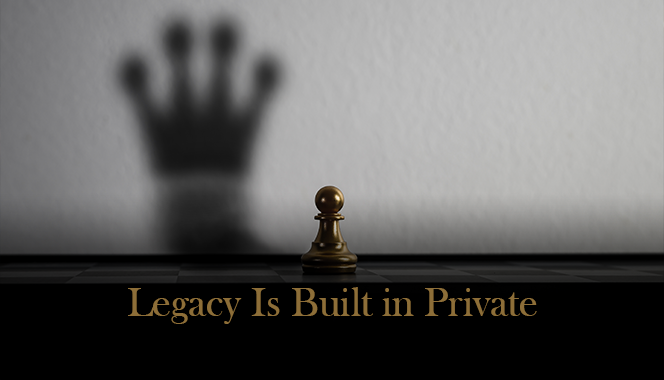
Legacy Is Built in Private
The decisions no one sees, the values no one applauds, the character no one is watching, that is where lasting leadership is actually forged.
Author: Worth Minds
Date: March 11, 2026
Legacy Is Built in Private
We live in an era obsessed with the visible. Highlight reels. Public announcements. Carefully worded statements of values are posted on websites and carved into lobby walls. We have become extraordinarily good at performing leadership by signalling the right things, at managing how we are perceived, and at building a public image that reflects the leader we want people to believe we are.
And yet, most of us know instinctively, even if we rarely say it, that the person someone is in public is not always the person they are when no one is watching. The real character, the real values, the real leadership, these reveal themselves not in the moments designed for visibility, but in the ones that aren’t.
Legacy is built there. In private. In the unglamorous, unobserved, unrecorded decisions that accumulate over years into something that either holds or doesn’t when the world finally gets a closer look.
The Gap Between Image and Identity
There is a distinction worth drawing carefully here, because it is one that modern professional culture tends to blur: the difference between reputation and character. Reputation is what others believe about you. Character is what you actually are. The two can align, and in the best leaders, they do, but they are not the same thing, and they are not built the same way.
Reputation is built publicly. It is shaped by performance, communication, and perception management. In a world of LinkedIn profiles, media coverage, and carefully curated thought leadership, building a strong reputation has never been more accessible or more formulaic.

Character is built differently. It is built in the moments of private decision, when you choose honesty over convenience, when you do the harder thing because it is right rather than the easier thing because it is unobserved, when you treat the person who can do nothing for you with the same respect you would show someone who could do everything for you.
Legacy, the kind that actually lasts, is downstream of character, not reputation. Which means it is downstream of what you do when no one is watching.
What Private Leadership Actually Looks Like
“The true test of a leader’s character is not the speech they give on stage. It is the conversation they have behind closed doors when the outcome no longer matters to their career.”
Private leadership is not mysterious. It is, in fact, quite ordinary, which is precisely why it is so easy to neglect. It is the email you take the extra ten minutes to write with care, even though a rushed reply would have been acceptable. It is the credit you give to someone who will never know you could have taken it. It is the standard you hold yourself to on a Tuesday afternoon in February, with no audience, no recognition, and nothing at stake except your own sense of who you are.
It is the mentor who stays after the meeting ends because they noticed someone struggling. The executive who, in a private debrief after a failure, refuses to let a scapegoat absorb blame they didn’t earn. The manager who, when they make a mistake, says so clearly, not because it will be noticed, but because not saying so would erode something in them they have worked hard to build.
These moments rarely make headlines. They rarely appear in the profiles written about successful people. But ask anyone who has worked closely with a truly great leader, one whose impact outlasted their tenure, whose influence extended beyond their title, and almost without exception, the stories they tell are private ones. Small moments that revealed something real.
Why Visible Success Can Be a Dangerous Distraction
One of the less-discussed risks of early professional success is that it can reward the performance of values before those values are genuinely formed. A leader who rises quickly learns, often unconsciously, that the appearance of integrity can be as effective as integrity itself, at least in the short term. The instinct to manage perception is not malicious. It is adaptive. The problem is that it can crowd out the harder, quieter work of actually becoming the person you are portraying.

The result is what might be called facade leadership: competent on the surface, hollow underneath. It can sustain itself for years, sometimes for an entire career, but it rarely builds anything that outlasts the leader’s own presence. When they leave, the culture they appeared to build tends to leave with them, because it was never really a culture. It was a performance.
The leaders who build something lasting whose teams remember them long after reporting lines have changed, whose organisations carry their influence forward, are almost always those who invested in the private architecture of their character with the same seriousness they gave to their public responsibilities.
The Disciplines That Shape Legacy
So, what does this look like in practice? How does a leader, especially one navigating genuine complexity, real pressure, and a world that rewards visibility, actually build the private foundation that legacy requires?
It starts with self-accountability: the habit of holding yourself to the standard you would hold others to, even when no enforcement mechanism exists. This is harder than it sounds. It requires building an interior compass that functions independently of external validation, one that does not rely on applause to stay calibrated.
It requires consistency across contexts. The leader who is generous in the boardroom and dismissive in the corridor is not actually generous. The executive who champions inclusion in policy documents but interrupts women in meetings has not built inclusion into their character. Legacy cares about what you do in both rooms, and it remembers the corridor more than the boardroom.
“Anyone can lead well when the stakes are high and the eyes are on them. The character that builds legacy reveals itself when both conditions are absent.”
And it requires the discipline of reflection, the willingness to ask, honestly and regularly, whether the private version of your leadership matches the public one. Not as an exercise in self-criticism, but as an act of integrity. The leaders who close that gap consistently are the ones whose legacy holds.
The Quiet Work That Compounds
Legacy is not announced. It is not engineered in a single defining moment. It is the compound interest of a thousand private decisions made well, over years, without an audience. It is the reputation you build with yourself, long before the world gets around to building one with you.
This is, in the end, both the challenge and the gift of private leadership. The challenge is that it offers no immediate reward. No one sees the harder choice you made in private. No one applauds the standard you quietly held yourself to. The work is invisible, and the returns are slow.
The gift is that no one can take it from you either. What you build in private in your values, your consistency, your character, belongs entirely to you. It cannot be spun, rebranded, or restructured away. When everything else shifts, as it always eventually does, it is the only thing that remains.
Build that, and you will not need to think much about legacy. It will take care of itself.

Key Takeaway
In a world that rewards the visible, the most consequential leadership work happens out of sight. Legacy is not a brand strategy or a farewell speech, it is the sum of who you chose to be when the outcome didn’t depend on anyone watching. The leaders worth remembering were building their legacy long before anyone thought to look. Start there. Stay there. The rest follows.

Worth Minds · The Orbit Edition
30 Stories Beyond Earth
Put your name forward for consideration and become part of a collection of stories designed to inspire generations.
Submit NominationCurrent Issue

Worth Minds · The Orbit Edition
30 Stories Beyond Earth
Put your name forward for consideration and become part of a collection of stories designed to inspire generations.
Submit NominationWorth Minds · The Orbit Edition
30 Stories Beyond Earth
Put your name forward for consideration and become part of a collection of stories designed to inspire generations.
Submit NominationCopyright © 2026 Worth Minds -
All Rights Reserved
All Rights Reserved