Legacy·Blog
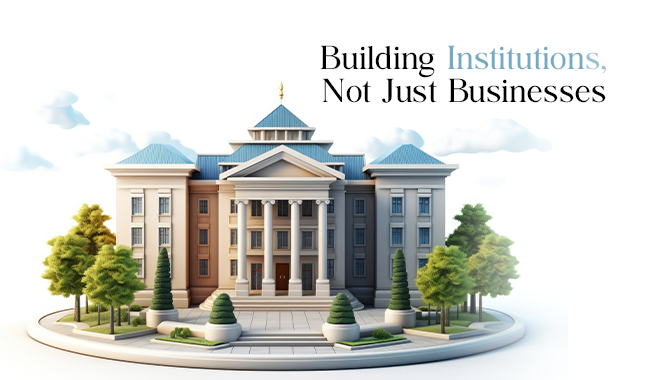
Building Institutions, Not Just Businesses
A business creates revenue. An institution creates meaning, standards, and a future beyond its founders. The difference is intention.
Author: Worth Minds
Date: March 29, 2026
Building Institutions, Not Just Businesses
There is a question that separates two fundamentally different kinds of leaders, and it is rarely asked directly: Are you building something that would survive you?
Not in the legal or financial sense, succession plans and exit strategies are well-understood categories of business planning. But in the deeper sense, is what you are building capable of carrying forward the values, the standards, and the purpose that made it worth building in the first place, without your continuous presence to hold it together? Is it a structure, or is it a performance? Does it have a life of its own, or does it depend entirely on yours?
These are the questions that distinguish the builder of a business from the builder of an institution. And while the distinction may seem philosophical, its practical consequences are among the most significant any leader will ever face.
What Makes Something an Institution
The word institution carries a certain weight; it tends to conjure images of universities, hospitals, central banks, and houses of parliament. Organisations that have existed for generations, whose names carry authority independent of the individuals who currently lead them. But institutional quality is not a function of age or scale. It is a function of design.
An institution, in the truest sense, is an organisation that has been built around principles rather than personalities. Its culture is not a reflection of its founder’s charisma. Its standards are not maintained by a single person’s vigilance. Its values are not decorative; they are structural. They are embedded in how decisions are made, how people are developed, how failure is handled, and how success is measured. They function even when no one of particular authority is watching.

A business, by contrast, can be built around a person. Many very successful businesses are. The founder’s energy, relationships, judgment, and appetite for risk drive everything. The culture is an extension of their personality. The standards are whatever they happen to insist on that week. It works, often brilliantly, while the person is present and engaged. What it cannot always do is survive their departure or their distraction, or their decline, or simply the passage of time.
“The test of an institution is not what it achieves while its founder is at full strength. It is what it upholds when they are gone.”
This is not a criticism of personality-driven businesses. They are often more innovative, more decisive, and more adaptable than their more institutional counterparts, precisely because they are not slowed by the weight of established process and distributed authority. The question is simply one of intention and time horizon. What are you building, and for how long?
The Philosophical Roots of Institution-Building
The impulse to build institutions is, at its core, a philosophical one. It reflects a particular orientation toward time, specifically, toward a future in which you will not be present. The institution-builder is, in a meaningful sense, in conversation with people they will never meet: the employees who will join the organisation a decade from now, the communities it will serve in a generation, the leaders who will carry its values forward without ever having known its founders.
Edmund Burke, the eighteenth-century political philosopher, described society as a partnership between the dead, the living, and the yet to be born. It is a formulation that applies with remarkable precision to the act of institution-building. When you build an institution, you are making a commitment that extends in both directions across time, honouring what was established before you and taking responsibility for what comes after.
This is a genuinely different orientation from the one that drives most business thinking, which is reasonably and necessarily focused on the present and near-term future. The institution-builder has to hold a longer frame. They have to ask not only what is working now? But what will still be true about this organisation when the circumstances that currently favour it have changed? That question forces a different kind of answer, one grounded in principle rather than strategy, in character rather than competency.
The Practical Architecture of Something That Lasts
Understanding the philosophical distinction is one thing. Building accordingly is another. What does it actually look like, in practice, to build an institution rather than simply a successful business?
It begins with the deliberate articulation and embedding of values not as a branding exercise, but as an operational commitment. Institutional values are not aspirational statements posted on walls. They are decision-making frameworks that are applied consistently, even when consistency is costly. The organisation that holds its integrity standard during a difficult quarter, when compromising it would solve a short-term problem, is building something institutional. The one that quietly sets the standard aside when it becomes inconvenient is building something more fragile than it realises.
It continues with an intentional approach to developing people rather than merely deploying them. Institutions invest in the growth of the individuals within them as a core function, not an HR benefit. They understand that their future depends not on the brilliance of a single founder but on the calibre of the leaders they are continuously producing. Every person developed into a stronger, more principled leader is a deposit in the institution’s long-term account.
And it requires the particular courage of designing systems that constrain even those who design them. The founder who builds governance structures, accountability mechanisms, and cultural norms that apply to everyone, including themselves, is making a profound statement: that this organisation is bigger than any individual within it, and that its integrity does not depend on anyone’s goodwill. That is an institutional act. And it is rarer than it should be.
“Anyone can build a business that works while they are running it. The harder, rarer, more significant achievement is building something that works because of how it was designed, not because of who is currently in charge.”
The Social Dimension of Institutional Thinking
There is a dimension to institution-building that extends beyond the organisation itself, and it is one that the most thoughtful founders and leaders have always understood: institutions do not merely serve the people inside them. They shape the communities around them.
An organisation that holds to genuine ethical standards raises the bar for the industry it operates in. One that develops its people generously sends better-prepared, more principled leaders out into the world. One that engages honestly with its responsibilities to its employees, its customers, its environment, and its community models a form of accountability that the broader culture needs more of, not less.
This is the social contract of institution-building. It is not charity or corporate social responsibility in the performative sense. It is the recognition that an organisation which takes significant resources from the world in the form of talent, capital, attention, and trust carries a genuine obligation to return something of corresponding significance. Institutions understand this. They factor it into their decisions not because it is good for their reputation, but because it is consistent with their values.

That consistency between stated values and actual behaviour, between private decision-making and public positioning, between what an organisation says it stands for and what it demonstrably does, in the end, what separates the institutional from the merely successful. It is the difference between a business that had a good run and an organisation whose influence outlasted its founders by decades.
A Closing Thought
The decision to build an institution rather than simply a business is not made once. It is made continuously, in the small choices that accumulate into culture, in the standards held when holding them is inconvenient, in the people developed beyond what the immediate role requires, and in the willingness to design something larger than yourself, something capable of carrying your values forward into a future you will not see. That decision is available to every leader, at every scale, in every sector. It does not require a large organisation or a long history. It requires only the long view and the discipline to build accordingly.

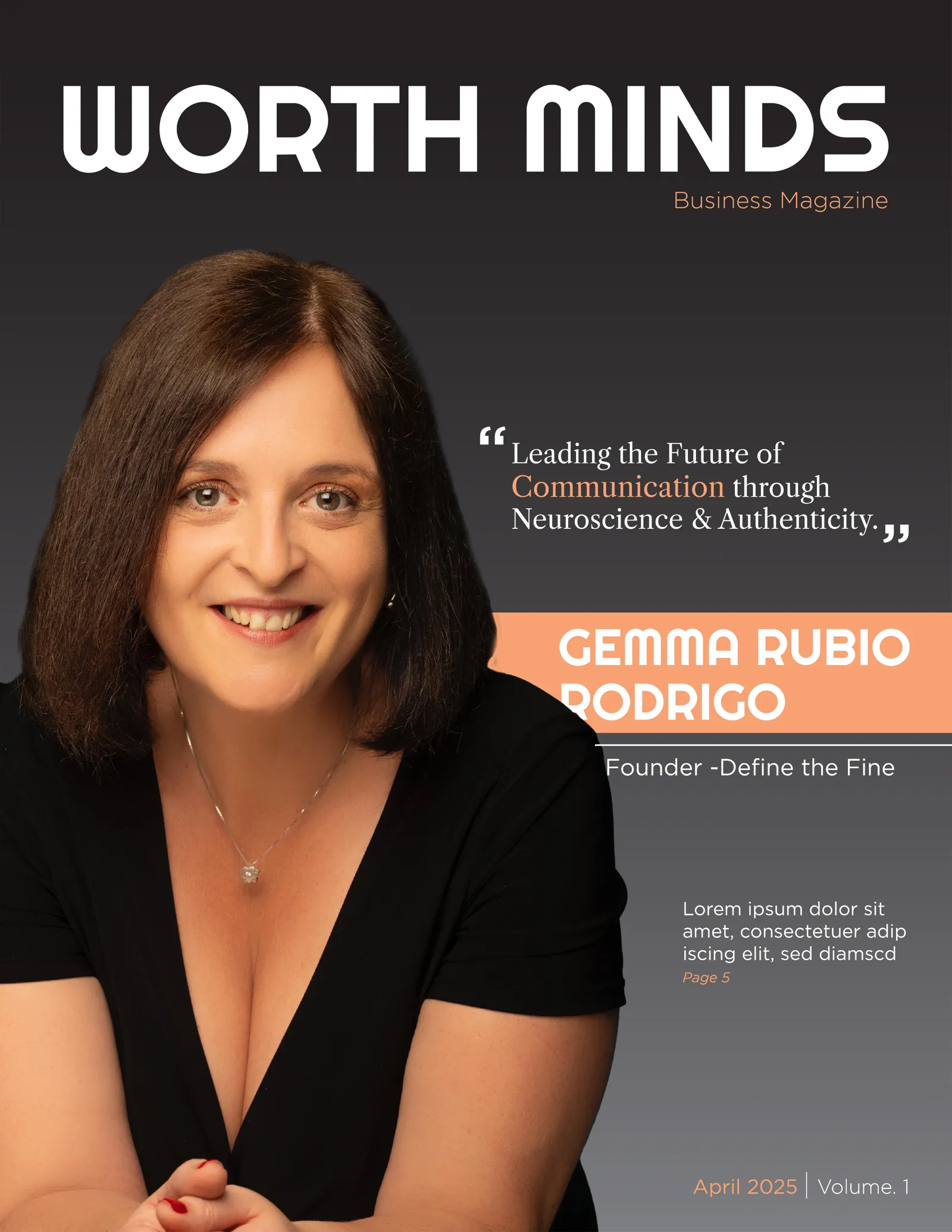
Worth Minds · The Orbit Edition
30 Stories Beyond Earth
Put your name forward for consideration and become part of a collection of stories designed to inspire generations.
Submit NominationCurrent Issue
Worth Minds · The Orbit Edition
30 Stories Beyond Earth
Put your name forward for consideration and become part of a collection of stories designed to inspire generations.
Submit NominationWorth Minds · The Orbit Edition
30 Stories Beyond Earth
Put your name forward for consideration and become part of a collection of stories designed to inspire generations.
Submit NominationCopyright © 2026 Worth Minds -
All Rights Reserved
All Rights Reserved