Leadership·Blog
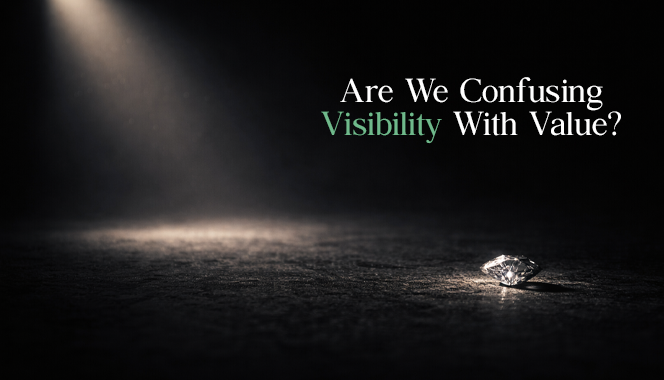
Are We Confusing Visibility With Value?
The most important work in the world is rarely trending, and those doing it aren’t waiting for permission to matter.
Author: Worth Minds
Date: March 24, 2026
Are We Confusing Visibility With Value?
Let us start with an honest question, the kind that is easy to dismiss quickly and worth sitting with slowly: When was the last time you did something genuinely valuable that nobody saw?
Not unnoticed in the sense of underappreciated. Unnoticed in the literal sense, no post, no mention, no record, no audience. Just the work itself and the difference it made. Can you remember? More importantly, did it feel like enough?
For a growing number of people, professionals, leaders, creators, ordinary human beings navigating a world of relentless social comparison, the honest answer is no. Not because the work was not meaningful. But because somewhere along the way, invisibility started to feel like inadequacy. Because the culture we are embedded in has quietly, systematically, taught us to confuse being seen with being significant.
That confusion is worth examining carefully. Because it is costing us more than we realise.
How the Confusion Took Hold
This did not happen because people are shallow or vain. It happened because the environments we operate in, social platforms, professional networks, and organisational cultures are built on visibility as the primary signal of value. Attention is the currency. Reach is the metric. The person with the largest audience is assumed to have earned it through superior contribution, and the person working quietly, without profile, is assumed, by the system if not always by the people around them, to be contributing less.

These assumptions are encoded into the architecture of how we work and how we present ourselves. Performance reviews that reward visible output over invisible contribution. Promotion decisions that favour those who are known over those who are quietly indispensable. Social platforms built on engagement mechanics that have no relationship to the quality of the thinking they amplify. The result is a professional and personal culture in which the incentive to be seen has grown so powerful that it has begun to displace the deeper incentive to actually build something worth seeing.
“We have built systems that are extraordinarily good at measuring attention. We are far less equipped to measure what attention is actually worth paying to.”
The philosopher Charles Taylor described what he called the age of authenticity, a cultural shift in which individual expression and self-presentation became primary values. What he could not have fully anticipated was the degree to which digital platforms would turn that impulse into a performance economy, where the authentic self becomes a personal brand, and the personal brand becomes a metric to be optimised. In that economy, the unobserved life begins to feel, almost involuntarily, like a lesser one.
What Value Actually Looks Like
Here is the corrective truth, stated plainly: the most consequential work being done in the world right now is almost certainly not the most visible work. It is being done by the researcher whose findings will reshape clinical practice in a decade. By the teacher who changed the trajectory of a classroom that history will never name. By the leader who built a culture of integrity inside an organisation that the press will never profile. By the mentor whose investment in one person rippled outward into a hundred lives they will never know about.
None of this is trending. None of it has a follower count. And none of it is diminished by the absence of an audience.
Value is not measured by who is watching. It is measured by what changes in people, in systems, in the quality of thinking applied to problems that matter. And a change of that depth seldom happens loudly. It happens in the patient accumulation of careful work, honest relationships, and decisions made well over a long period of time.

This is not an argument against visibility. When genuine value is visible, that visibility serves a real purpose, it spreads good ideas, creates access, and connects people who need to find each other. The problem is not visibility. The problem is mistaking it for the thing it is supposed to represent. The map is not the territory. The signal is not the substance.
The Personal Cost of Chasing the Wrong Metric
There is a particular kind of exhaustion that comes from spending a significant portion of your professional energy on being seen. It is different from the tiredness that follows a day of genuinely hard work, which, however depleting, carries with it a residue of satisfaction. The exhaustion of visibility-chasing is hollower. It does not replenish. Because at some level, even when the metrics are good, you know that what you have produced is an impression, not a contribution.
Psychologists who study motivation have long distinguished between intrinsic and extrinsic drivers of behaviour. Work driven by genuine interest, purpose, and the satisfaction of doing something well tends to be more creative, more sustained, and more resilient under pressure. Work driven primarily by external validation, by how it will be received, measured, and rewarded, tends toward the conservative, the performative, and the fragile. It is good at looking right. It is less good at being right.
When your primary question shifts from What does this work actually accomplish? to How will this look? something fundamental changes in the quality of what you produce, and in the quality of what you experience producing it. The work becomes a vehicle for perception rather than a vehicle for contribution. And you begin, slowly and almost imperceptibly, to lose touch with the thing that made the work worth doing in the first place.
“The moment you start doing the work for the audience rather than for the outcome, you have already started building something less durable than you intended.”
Reclaiming the Standard
The recalibration starts with a deliberate act of internal clarification: deciding, consciously and in advance of the day's pressures, what you are actually trying to build. Not how you want to be perceived, but what you want to be true, about the quality of your work, the integrity of your conduct, and the impact you have on the people and problems in your orbit.
That clarity does not make the pull of visibility disappear. It gives you something solid to return to when the pull is strongest, a standard that belongs to you rather than to the audience. It allows you to use visibility as a tool rather than chase it as a reward.

It also requires the quiet courage to do genuinely important work in genuinely unimportant-looking ways. To mentor without announcing it. To lead without performing leadership. To build without narrating the construction. To trust that value witnessed only by the people it directly serves is not a lesser value; it is, in many cases, a purer value, because the distortions of an audience never shaped it.
The people who will look back on their careers with the deepest satisfaction are rarely those who were most visible. They are those who were most useful, who made the right calls, built the right things, and served the right purposes, with or without the world watching. That usefulness compounds quietly over decades into something that no algorithm can generate, and no metric can fully capture.
It is, in the truest sense, the only kind of value that lasts.
A Closing Thought
You do not need more people to see you. You need to be clearer about what you are building and why it matters. The work that will define your contribution is almost certainly not the work that generates the most reaction; it is the work you do when the reaction is irrelevant, when no one is counting, and when the only reward is the quiet knowledge that you did it well. Start measuring that. It will change everything else.

Worth Minds · The Orbit Edition
30 Stories Beyond Earth
Put your name forward for consideration and become part of a collection of stories designed to inspire generations.
Submit NominationCurrent Issue

Worth Minds · The Orbit Edition
30 Stories Beyond Earth
Put your name forward for consideration and become part of a collection of stories designed to inspire generations.
Submit NominationWorth Minds · The Orbit Edition
30 Stories Beyond Earth
Put your name forward for consideration and become part of a collection of stories designed to inspire generations.
Submit NominationCopyright © 2026 Worth Minds -
All Rights Reserved
All Rights Reserved